Senin, 16 Juli 2012

The Real Housewives of Windsor


It’s hard to believe that it has been 13 years since Sophie Rhys-Jones walked down the aisle at St. George’s Chapel, Windsor and walked out as HRH, The Countess of Wessex. From the beginning, Sophie seemed determined to do things differently than previous Windsor Wives and for a while it looked like she might succeed. She was going to be a working wife, continuing to pursue her career in PR, while fulfilling royal duties as needed. She even talked of putting of having royal offspring while she and Edward enjoyed married life. Over the past 13 years, Sophie has weathered a host of storms including infertility, racy photos, questions about her business and a tabloid scandal that rocked the monarchy but Sophie came through relatively unscathed and has even taken the former Kate Middleton under her wing to teach her the ropes.

When her relationship with Prince Edward was first revealed to the public, Sophie was often compared to Princess Diana. Both were tall, leggy blondes with short hair and English rose complexions, close in age (Diana was born in 1961, Sophie in 1965), but the resemblance was only on the surface. While Diana came from an aristocratic background, Sophie came from a decidedly middle-class one. Her father, Christopher, was a successful retired tire salesman, and her mother Mary was a secretary. Sophie’s mother even took in typing at home to help send her and her brother David to Dulwich Preparatory School and then to West Kent College.

While Diana used to joke that she was “thick as a plank,” Sophie obtained 8 O-levels and 2 A-levels in English and Law. Diana’s parents famously split up when Diana was little; Sophie’s parents were happily married until her mother’s death in 2005. Before her marriage, Sophie trained as a secretary and had a successful career in public relations, while Diana flitted from one low-paying job after another. Diana was a very immature 20 years old when she married Prince Charles after a short courtship. Sophie was a mature woman of 34 who had dated her prince for over five years before she walked down the aisle at St. George’s Chapel, Windsor. Diana and Fergie’s family had royal connections stretching back centuries, Sophie’s only connection was that she was descended from the 1st Viscount Molesworth, a 17th century diplomat with links to the Stuart Kings of England and the Queen Mother, making Sophie and Edward cousins of sorts. While Diana had to contend with the continued presence of Camilla Parker-Bowles in her husband’s life, Sophie had to contend with rumors that Prince Edward was gay.

Sophie even met her Prince like other modern couples, through her job. The couple met at a strategy meeting to discuss The Real Tennis Challenge, an event to raise funds for the Duke of Edinburgh’s scheme in 1993. Sophie later ended up standing in for Sue Barker for the photo-call with Edward, her hand resting lightly on his shoulder. She expressed interest in the game of ‘real tennis’ (the version that Henry VIII would have played) which was Edward’s sporting passion. Intrigued, Edward asked her out. Somehow they managed to keep the relationship secret for three months before the tabloids found out.

To the royal family, Sophie must have seemed like a breath of fresh air. They were under pressure when she came on the scene. The monarchy was facing criticism from over everything from the Civil List, whether the Queen should pay taxes, as well as the disastrous marriages of the royal children. Sophie was neither a compassionate fashion icon like Diana nor a loose cannon like Sarah Ferguson. “You wouldn’t notice her in a crowd,” the Queen was overheard telling the Queen Mother and Princess Margaret. Sophie was seen to be unthreatening, a mixture of solid middle-class conventionality mixed with media modernity. Colleagues from work described her as always game for a laugh and down to earth. The editor of OK! Magazine, one of her clients, said “She’s not a girl of extremes and that’s essential to her character. She’s a person who can cope.” Together Sophie and Edward seemed as sexy and exciting as bread pudding. Sophie got along with most of the Royal Family especially Prince Philip but also Princess Anne who had never befriended either of her two previous sisters-in-law. Princess Diana allegedly called Sophie, “little Miss Goody Two Shoes,” behind her back.

The couple announced their engagement their engagement in January of 1999. At the press conference, the couple held hands affectionately as they showed off Sophie’s ring. Unlike his older brother Prince Charles, who famously declared, ‘whatever in love means,’ Edward said, “We are the best of friends and we happen to love each other very much.’ When asked if she found the prospect of joining the Royal Family daunting, Sophie answered honestly, ‘It is slightly nerve-racking in many ways. But I am ready for it now and I am fully aware of the responsibilities.’ Sophie had time to get a good look at royal life over the past several years. She’d been invited to join the Queen for family holidays at Windsor, Balmoral and Sandringham. A blind eye was turned when Sophie spent the night with Prince Edward at Buckingham Palace. She was even given her own pass to come and go as she pleased. She became well acquainted with the “men in grey” who had made Diana and Fergie’s lives as Royals so difficult. Both Diana and Sarah were jealous that Sophie was getting special treatment they had been thrown to the wolves. Prince Edward had even taken the step of sending an open letter to the press asking that they back off of Sophie. Sophie seemed almost too good to be true.

Three weeks before wedding, the first scandal hit the headlines. London's biggest tabloid, The Sun, printed a topless picture of Sophie. What should have been a tempest in a teapot became a national uproar in the wake of Princess Diana's death, which was widely blamed on Fleet Street's disregard for royal privacy. The outcry was so enormous the tabloid Sun actually issued a groveling apology. The 11-year-old snapshot showed Sophie gallivanting with radio disc jockey Chris Tarrant during a 1988 business trip to Spain. At the time, Sophie was working for Capital Radio as a PR executive. The picture showed Tarrant pulling up a laughing Sophie’s bikini top, exposing one breast. The photographer, Kara Noble, was paid £40,000 for the photo but in the backlash after their publication, she was sacked from her job as a disc jockey. While the scandal was tame compared to the pictures of a topless Fergie having her toes sucked in the South of France, the publication signaled the end of the honeymoon between Sophie and the Press.

The nuptials of Sophie and Edward on June 19, 1999 were a much more low-key affair than his siblings’ weddings, which took place at Westminster Abbey and St. Paul’s Cathedral. Since all three of those weddings ended in divorce, perhaps Prince Edward was hedging his bets by getting married at Windsor. Whatever the reason, Edward and Sophie had made it clear that their wedding was not to be a state occasion. On his wedding day, he was created The Earl of Wessex. Sophie’s new title would be HRH The Countess of Wessex. Eventually the plan was that after the Queen and the Duke of Edinburgh’s death, Edward would inherit his father’s title. The wedding was attended by 560 guests and an estimated 200 million viewers around the world. Some commentators called it the “people’s wedding,” and 8,000 people were picked at random and invited into the castle grounds.

Unlike the over-the-top 80’s confections worn by Diana and Sarah, Sophie wore a simple dress made of hand-dyed silk organza and silk crepe, with long sleeves and the detail consists of rows of pearls and crystal beading around the neck, sleeves and train, with further beading down the back and front of the dress-coat. 325,000 cut-glass and pearl beads were sewn on the dress, which was corseted, with a V-neck. To accompany the dress, the bride also wore a black-and-white pearl necklace, interspersed with white gold rondels, and a matching pair of black-and-white pearl drop earrings, designed by Prince Edward and made by Asprey and Garrard as a wedding gift from Edward. Sophie wore a diamond tiara, from the Queen's private collection, consisting of three open-work scroll motifs, designed and re-modeled by the Crown Jeweler, David Thomas, and Asprey and Garrard.

Soon after their wedding, it was announced that the royal couple would be balancing their professional lives with their royal duties. The Queen was said to be behind the couple’s decision. The couple took a 150 year lease on the 57 room Bagshot Park in Surrey, paying £5 million pounds for a property that on the open market would be worth at least 6 times as much. It is one of the largest Royal homes; even Prince Charles’s beloved Highgrove is not as big. Prince Edward went back to work at the moderately successful production company that he’d started in 1993, Ardent Productions while Sophie continued on with her PR firm RJH. But from the beginning there were questions about whether royalty and commerce should mix. Even before the wedding, Sophie was accused of using her relationship with Edward to drum up business. The longer her romance with Edward continued, the more her career seemed to flourish.

Her critics said a big “I told you so,” when in 2001, an undercover reporter for the tabloid News of the World, Mazher Mahmood, posing as an Arab sheikh, recorded Sophie making disparaging remarks about Cherie Blair as "absolutely horrid, horrid, horrid" and criticized the prime minister's leadership style as "too presidential". It was also claimed that she boasted that she was the Royal family’s savior and calling the Queen ‘the old dear.’ It also appeared that Sophie was using her royal connections to drum up business. The story was picked up by the Daily Mail and other media outlets, humiliating the Countess. Although Buckingham Palace issued a statement suggesting that the reported comments were ‘selective, distorted and in several cases, flatly untrue,’ the damage was done. Sophie herself issued a statement that read, that she regretted the embarrassment she had caused after being taken in by the reporter's scheme. “I am deeply distressed by the carrying-out of an entrapment operation on me and my business but I also very much regret my own misjudgment in succumbing to that subterfuge.” For a supposedly smart and savvy business woman, it never seems to have occurred to Sophie to check out her new potential client. Landing such a lucrative account seemed to outweigh her common sense. Unlike Fergie who could at least claim alcohol as an excuse, Sophie drank nothing but mineral water during the meeting.

The news brought back memories of ‘Squidgygate’ and ‘Tampongate’ when the Wales’s phone calls were taped and then published in the tabloids. Sophie compounded her error by sending personal letters of apology to Blair, Hague and Prince Charles. The tabloid turned over the tapes to Buckingham Palace in exchange for a 5 page interview with Sophie, in which she discussed IVF & Edward’s sexuality. Instead of being a breath of fresh air, Sophie was in danger of been seen as no better than her predecessors. Her partner resigned but Sophie was hoping to ride it out but clients began to leave, outraged by publicity. Later that fall, Prince Edward got into trouble for filming at St. Andrew’s University as his nephew Prince William matriculated for a documentary. In 2002, both the Prince Edward and his wife announced that they would quit their business interests to focus on royal duties full time and to aid the Queen during her Golden Jubilee. To take some of the sting out having to give up their careers, the Queen increased the annual allowance to £250,000, essentially paying them not to work.

Sophie, by all accounts, was devastated at having to give-up the business that she had worked so hard at developing for a life of ribbon-cutting and garden parties at Buckingham Palace. She had founded RJH in 1996 with her business partner Murray Harkin, and had been a dedicated career woman before her marriage. The company had a prestigious client list that included the Lanesborough Hotel in London, Boodles & Dunthorne, Thomas Goode China, DFS Furniture chain, Rover Cars, and the Banyan Tree Hotel in Phuket, Thailand. According to an article in London’s The Daily Mail, the company was in talks to sell the business for £3.5 million (8 years later the company folded owing £1.7 million). However devastated she might have been, she also seemed resigned that if she wanted her marriage to work, she would have to make a success of her life as a royal instead. There were some who took great delight in her downfall, who felt that Sophie had developed a case of ‘red carpet fever’ when she married the Queen’s youngest son, that she got caught up with being a member of the Royal Family. She’d once remarked that she was the ‘second lady of the land’ and apparently had the attitude that went along with it.

If that wasn’t bad enough, Sophie also had problems conceiving. In December of 2001, Sophie was brought to King Edward VII Hospital after complaining that she didn’t feel well. It was soon discovered that she was suffering from an ectopic pregnancy. She lost both the baby and an ovary. Two years later, she went into premature labor, resulting from a placental eruption, giving birth to a daughter Lady Louse on November 8, 2003. Sophie had to have a caesarian, and it was touch and go for a while for both mother and daughter. She lost a considerable amount of blood, and was said to be 20 minutes away from death. And then their daughter, Louise, was born with extropia, an eye condition that left her with one eye turning outwards. Longing for a second child, the couple went through a number of unsuccessful IVF treatments, before conceiving their son James, Viscount Severn (born December 17, 2007), naturally after almost four years of trying. It was an emotionally devastating time for Sophie, who had to watch several women on staff at the Palace give birth, while she struggled to conceive. Neither children will either have or use the style HRH at their parents’ request. Both Sophie and Edward wish for them to have as normal an upbringing as possible.

Through it all, the Queen has been a huge supporter of Sophie. They share a strong bond and an interest in military history, and horses. Sophie is reportedly the first of The Queen’s daughters-in-law with home she has enjoyed a permanently warm relationship. While The Queen’s relationship with Camilla has thawed, they will never truly be close, and so far Prince Andrew has declined to remarry after his divorce from Fergie. The Queen even went so far as to pay a secret visit to Sophie when she was in the hospital after the traumatic birth of Lady Louise which was unprecedented. They became even closer after Sophie lost her mother to cancer in 2005. The Queen and Sophie take regular horseback rides around Windsor Great Park, and the Queen has even been known to pop around for tea at Bagshot Park unannounced. In 2010, Sophie was made a Dame Grand Cross of the Royal Victorian Order. Honorees are chosen by the Queen personally for this honor rather than recommended by the Prime Minister.

Now 47, Sophie has proved to be a valuable member of the Royal Family. Unlike the Duchess of York who keeps making the same mistakes over and over again, but expecting a different result, Sophie learned from her earlier mistakes, and has not put a foot wrong since. She has even stepped it up fashion-wise in recent years, showing off a trimmer figure, and more stylish wardrobe of tall hats, and platform shoes. Articles in such diverse publications as Hello Magazine, The Telegraph and Majesty Magazine have all remarked on her transformation over the years. Another sign of how well thought of Sophie now is, she volunteered to take Kate Middleton under her wing, to show her the royal ropes after her engagement. She’s also become good friends with Princess Charlene of Monaco. Over the years, Sophie has been able to use her PR skills to good use to help the charities she’s patron of, including Born in Bradford research project, which investigates the causes of low birth weight and infant mortality.

Edward and Sophie are now the Queen’s go to Royals to represent her on overseas trips and at royal weddings. In 2011, they attended the wedding of Prince Albert II of Monaco to Charlene Wittstock. To celebrate the Queen’s Diamond Jubilee, they traveled to the Caribbean as well as a controversial trip to Gibraltar. As the Queen and Prince Philip cut back on their engagements, Sophie and Edward will no doubt continue to have a high profile until Prince William and the Duchess of Cambridge become full-time royals.


Minggu, 15 Juli 2012

Review: FAREWELL, MY QUEEN


Cast

Léa Seydoux as Sidonie Laborde
Diane Kruger as Marie-Antoinette, Queen of France
Virginie Ledoyen as Gabrielle de Polastron, duchesse de Polignac
Xavier Beauvois as Louis XVI
Grégory Gadebois as Louis, comte de Provence
Francis Leplay as Charles, comte d'Artois
Noémie Lvovsky as Jeanne-Louise-Henriette Campan
Vladimir Consigny as Paolo
Julie-Marie Parmentier as Honorine
Michel Robin as Nicolas Moreau
Lolita Chammah as Louison
Marthe Caufman as Alice
Jacques Boudet as Monsieur de la Tour du Pin
Martine Chevallier as Madame de la Tour du Pin
Grégory Gadebois as Comte de Provence
Jacques Nolot as Monsieur de Jolivet
Serge Renko as Marquis de la Chesnaye
Anne Benoît as Rose Bertin
Dominique Reymond as Madame
Jean-Chrétien Sibertin-Blanc as Monsieur de Polignac
Jacques Herlin as Marquis de Vaucouleurs

Synopsis:  1789, at the eve of the Revolution, Versailles' occupants still live happily, unconcerned by the increasing turmoil in Paris. When news about the storming of the Bastille reaches the Court, aristocrats and servants desert the Palace, leaving the Royal Family alone. But Sidonie Laborde, a young servant who reads to the Queen, refuses to flee. She feels secure as she is under protection of the Queen of France. She does not yet know these are the last three days she would spend by her side.

My thoughts:  Since yesterday was Bastille Day, I thought it highly appropriate to see the new film FAREWELL MY QUEEN, starring Diane Kruger as Marie Antoinette and Lea Seydoux as Sidonie Laborde, the young reader to the Queen, a minor office but one that gives her a certain prestige amongst the other servants and access to areas of Versaille that others do not have.  The highlight of this film for me was seeing Kathleen  Turner standing on the line to see the movie.  I knew going in that I probably was going to be disappointed but I had no idea how much.

This film was BORING, vapid, and uninspiring, did I mention it was also BORING? The running time is about 90 minutes, but it felt like it took four hours to get through this film, there were moments when I was nodding off in my seat, it was that dull. The French Revolution took less time and was more interesting than this film. Despite the fact that the movie was filmed at Versaille, it looked like the budget was about 50,000 Euros.  I'm also no expert on 18th century costume, so I can't accurately state whether or not the clothing in this film is historically correct for 1789, but I welcome comments to that effect.  The film also seemed to be edited funny, scenes would end with almost a cliffhanger but then the next scene had nothing to do with the previous scene, it was as if scenes had been cut out in the diting process.

The movie is based on a novel by Chantal Thomas, who also co-wrote the screenplay.  Thomas also also written a well-regarded work of non-fiction detailing how Marie Antoinette was demonized by the pamphleteers of the time. The director claims that he was inspired by Thomas's feminist take on the story of Marie Antoinette.  That probably explains the lingering shots of nudity of both Madame de Polignac and Sidonie in the film.  I found it particularly shocking that Thomas, who did so much to disprove the lies about Marie Antoinette, particularly the rumors that she was a lesbian, would be part of a film that does nothing but perpertrate those same lies.  Seriously, WTF?

Lea Seydoux, who plays Sidonie, spends most of the film looking either sullen or petulant when she's not eavesdropping on private conversations.  The audience keeps being told how devoted Sidonie is to Marie Antoinette but we never learn why or really see it.  Most of the time, she looks put upon. The film also intimates that Sidonie's feelings for Marie are of the sapphic variety.  Can someone tell me when did feminist and lesbian become the same thing? Diane Kruger, ironically, actually impressed me as Marie Antoinette, although physically she doesn't resemble the Queen at all. I've never been a huge fan of Diane Kruger, apart from the National Treasure films, for the most part I think the roles that she's played have required her to do nothing more than look pretty (see Troy). To me she's been just another model turned actress, one who shows up at premieres looking fabulous but that's about it. However in this film, there was actual acting going on.  I felt for her when she was telling Sidonie about her feelings for Madame de Polignac, and her good-bye scene with her love, even though inwardly I cringed.

One thing the film does well is to give the audience a glimpse into what it was like backstairs at Versailles compared to the aristocracy.  We witness the servants in their small rooms upstairs in the attics of the palace to their downstairs lives in the dining rooms and corridors in the lower levels of the palace.  We see the intrigues, the romances and hear the gossip about those who live above stairs. Sidonie and Madame de Campan apparently each have only one dress which they wear daily, Sidonie has to contend with mosquito bites and the poor sewage at the Palace.  We also see the rooms of the minor nobility compared to the luxurious apartment of Marie Antoinette.  However, unlike the synopsis of the film on Wikipedia, we don't really see aristocrats and servants deserting the palace.  We do however hear a lot of talk about what is going in Paris with the fall of the Bastille.  In the end though it didn't matter, because for the life of me, I couldn't figure out what the point of the film was.

After the movie, I walked over to Cafe Boulud to have a nice glass of rose and a chocolate eclair to help wipe away the memory. I think the final word on this film can be summed up by what I overheard another audience member say on the line in the ladie's room, "What a waste!"

Senin, 09 Juli 2012

Lucy Worsley presents Harlots, Housewives and Heroines: A Girl's Guide to the 17th Century


So it's been wicked hot here in New York, too hot to do much of anything but lay around near the air conditioner and watch TV.  My new favorite is Harlots, Houswives and Heroines presented by Dr. Lucy Worsley which was orignally shown on BBC 4 in the UK. Lucy is the Chief Curator at Historic Royal Palaces, the independent charity looking after The Tower of London, Hampton Court Palace, Kensington Palace State Apartments, the Banqueting House in Whitehall, and Kew Palace in Kew Gardens, so she really knows her stuff. She's also the author of the fabulous books Courtiers and If These Walls Could Talk (also available on You Tube).

I must confess that I have a bit of a girl crush on Lucy Worsley ever since I watched the programme on Henry VIII on National Geographic that she presented. I suspect that she would be loads of fun to have a drink with.  She seems equally fun in the programmes that she's presented for BBC4.  In fact my dream evening would be to have dinner and drinks with Lucy, Hallie Rubenhold (who also pops up in the series), Amanda Vickery, Amanda Foreman and Kate Williams. This series is after my own heart.  Not only is it set in one of my favorite centuries, but it is filled with fun Scandalous Women. Many of them have appeared on this blog including Barbara Palmer, Nell Gwynn and Catherine Sedley. But I've also been introduced to some fabulous women that I'd never head about such as Margaret, Duchess of Newcaste and Elizabeth, Duchess of Lauderdale (you can expect posts soon on these two women!).  There are also loads of dishy portraits of Charles II, who is my favorite King of England.

Thanks to Evangeline Holland of Edwardian Promenade, we can watch all 3 episodes on YouTube as well as Lucy's other programme on The Regency era. I wish that someone would do an American version of this.  It would be fascinating to learn about some of the personalities living in the colonies during this period such as Anne Hutchinson, Elizabeth Winthrop and Pocahontas. Are you listening to me History Channel?

Minggu, 01 Juli 2012

Equal of the Sun: A Novel by Anita Amirrezvani

Title:  Equal of the Sun - A Novel

Author: Anita Amirrezvani

Publisher:  Scribner (Simon & Schuster)

Pub Date:  June 5, 2012

Pages: 431

What it's About:  Iran in 1576 is a place of wealth and dazzling beauty. But when the Shah dies without having named an heir, the court is thrown into tumult. Princess Pari, the Shah’s daughter and protégé, knows more about the inner workings of the state than almost anyone, but the princess’s maneuvers to instill order after her father’s sudden death incite resentment and dissent. Pari and her closest adviser, Javaher, a eunuch able to navigate the harem as well as the world beyond the palace walls, are in possession of an incredible tapestry of secrets and information that reveals a power struggle of epic proportions.

My thoughts:  Equal of the Sun is very different from most of the historical fiction that I read. I was very excited at getting a chance to read about a powerful woman who wasn't a Tudor or Queen Victoria.  Historical fiction nowadays tends to be very Eurocentric, focused primarily on 100 years of history.  It's a rare treat that readers get to enter a world that is not familiar. Equal of the Sun is an intriguing look behind the scenes of 16th century Iran or Persia. Before reading this book, I had only been familiar with the Ottoman Empire thanks to the historical romance novels of Bertrice Small! Anita Amirrezvani pulls back the curtain to reveal the manueverings and jockeying for position that takes place after the death of the previous Shah. Her descrip­tions of the ancient tra­di­tions and the cul­ture of Iran is one of most cap­ti­vat­ing aspect.

While the inside cover of the book indicates that the novel is about Princess Pari Khan Khanoon Safavi, the book is really more about her eunuch Javaher.  He narrates the story of what happens during this pivotal year.  I found this to be both one of the books strengths but also it's weakness.  We never really get to know Princess Pari because Javaher never really gets to know her.  He's her servant as well as her eyes and ears in the outside world. I felt that by focusing on Javaher so much, and not at least having the book narrated by Pari at least in part, the reader is kept at a distance, as male visitors are kept by the lattice when they come to speak with Pari. What the readers does get to know about Pari is fascinating. Here you have a dynamic, intelligent woman who because of the culture and traditions of her country is never able to fully use her talents.  It's clear that Pari would have made a most excellent Shah if it had been possible for women to rule. She's also stubborn, and is always convinced that she is right, which is one of her less attractive qualities.

Javaher is a unique character.  Unlike most of the eunuchs at the Palace, he chose to become one, at the late age of 17. While he is intensely loyal to the Princess, he also is not afraid to tell her things that she might not want to hear. I quite enjoyed reading his take on all the politics and the royal family.  The book is filled with excerpts from Persian poetry which I also found quite enjoyable.

Amirrezvani is a mesmerizing story-teller, I was enthralled by this new world from page one. While I was never bored while reading the book,  I did however become increasingly frustrated because the book revolves a great deal around Javaher as well as his quest to find out the truth of his father's murder. There's also a great deal of background concerning the various tribes that took up a great deal of the book. I found myself constantly flipping to the front of the book to remind myself who the various characters. However, the strengths of the book far outweigh the weaknesses.

For anyone who loves historical fiction and wants a change of pace from European settings and characters, I highly recommend you pick up a copy of this book. Hopefully this book will give readers more of an insight and knowledge into the country of Iran.

Senin, 25 Juni 2012

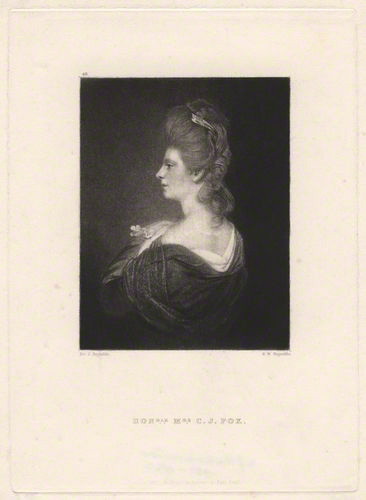
The Scandalous Beginning of a Timeless Romance: Charles James Fox and Elizabeth Armistead


Scandalous Women is please to welcome author Deborah Hale to the blog. After a decade spent tracing her ancestors to their roots in Georgian-era Britain, Deborah Hale learned a great deal about the period and uncovered enough fascinating true stories to inspire her fiction plots for years to come. In 1997, Deborah won Romance Writers of Amercia's Golden Heart award and several months later sold her winning manuscript to Harlequin Historical. Since then she has written many historical romance novels with a variety of settings, as well as two other-world fantasies for Luna Books. In the pilot episode of the hit television series "Hustle" one of Deborah's books was used in a key scene! Deborah lives in beautiful Nova Scotia, Canada, a place steeped in history and romance.
As Elizabeth Charles, she is the author of the new historical fiction novel CONFESSIONS OF A COURTESAN which came out in 2011 about the 18th century courtesan, Elizabeth Armitage. Welcome Deborah!

In 1802 British statesman Charles James Fox dropped a bombshell by announcing that he had been secretly married for the past seven years to the woman hed openly kept as his mistress for twelve years before that one of the most celebrated courtesans of the Georgian era, Elizabeth Armistead. Their relationship, chronicled by I.M. Davis in The Harlot and the Statesman and Katie Hickman in Courtesans, was one of the great love stories of all time.

Before Fox and Mrs. Armistead became lovers, they had been increasingly close friends for at least eight years. His Parliamentary faction, who vigorously opposed Britain making war on the American colonies, often gathered at her house on Clarges Street for dinner parties where they discussed political strategy. Because of her close association with them, the press dubbed her “The High Priestess of Patriotism.” But how exactly did these unlikely lovers meet? That is a story stranger and more scandalous than fiction…

In 1775, twenty-five-year-old Elizabeth Armistead was working as a prostitute in one of the exclusive brothels in Londons West End that catered to men of the highest distinction and greatest fortunes. She must have been clever and fascinating and lucky to have lasted that long in a business where teenage virgins were highly prized. But at her age, Mrs. Armistead must have wondered when her luck might run out and she would end up pregnant, poxed or turned out to make room for fresh stock. If any of those things happened, she would face a bleak future indeed.

One particular night Elizabeth Armistead was entertaining Lord Bolingbroke, a courtier and horse breeder, recently divorced from Lady Diana Spencer. Bully Bolingbroke had kept many of the most celebrated courtesans of the day, including Nelly OBrien and Polly Jones, who had both been painted by Sir Joshua Reynolds. While he and Mrs. Armistead were in bed together there came a disturbance at her door. A group of Bullys friends from his club demanded entry.

The party included Lord Egremont, who many years later recounted the story in a letter to Lord Holland. Egremont reported that Charles Fox was another member of the group and where Fox went his bosom friends Richard Fitzpatrick, James Hare and Bullys brother-in-law Lord Robert Spencer were sure to have followed. The gentlemen had been gaming at their club with a visiting French aristocrat (most likely the Duc de Lauzon) and fell into a debate over whether the bawdy houses of London or Paris were superior. To prove their point, Fox and his friends took the Duc to a house nearby. When they learned their friend Bully was being entertained on the premises, the group decided to surprise him.

Egrement would later write, “Bully, as they called him was in bed with a Lady and they kicked the door open and she (Armistead) was the Lady.” History does not record how either Mrs. Armistead or the irascible Bolingbroke reacted to the intrusion, but within a short time he had taken her into exclusive keeping and arranged for her to make her stage debut at the Haymarket Opera House. Elizabeth Armistead did not seem to take offense at the prank. By the early months of 1777, when Richard Fitzpatrick was sent to fight in America, she was sufficiently close friends with both he and Fox that she wrote letters to him sealed inside Foxs.

Eventually friendship ripened into the deepest kind of love. Elizabeth Armistead gave up her glittering life as Londons most celebrated courtesan and retreated to the secluded serenity of a small house in the Surrey countryside, which she shared with Fox. When his debts mounted, she assisted him by selling the two London houses and two annuities she had worked so hard to accumulate and which were her only security against destitution. Fox in turn adored her and wrote her some of the most touching love letters ever penned.

In time Elizabeth Armistead managed to leave her scandalous past behind her and become respectable mainly by outliving so many of her contemporaries, but also due to her own kindness and likeability. She always treasured a soft spot for the family of Bully Bolingbroke, who had first raised her “from the lower ranks of her profession & introduced her into better company.” She doted upon his two sons, their children and grandchildren, who visited frequently, wrote often and sent their children to stay with her as they would with a fond grandmother. A particular favourite was young Bob St. John, the illegitimate child of an incestuous relationship between Bullys son and his half-sister (but that is a scandalous story for another day…)

It must have been the St. John family on whom Lord Egremont reflected in later years when he paraphrased scripture in a letter to Foxs nephew: “Mrs. Fox is a very kind-hearted woman & now very religious and she seems to have taken the good qualities of God Almighty without his atrocious ones by shewing mercy unto the third and fourth generations if, not quite, thousands who have loved her and kept her commandments.”

Sources:

Davis, I.M. The Harlot and the Statesman. The Kendall Press, 1986  
Hickman, Katie. Courtesans. Harper Collins, 2003Linnane, Fergus. Madams, Bawds and Brothel Keepers of London, Sutton Publishing, 2005
Tillyard, Stella. Aristocrats. Chatto and Windus, London, 1994

Rabu, 20 Juni 2012

Joyce McKinney and the Manacled Mormon

“I loved him so much I would ski down Mount Everest naked with a carnation up my nose for the love of that man.” – Joyce McKinney


The story of Joyce McKinney and the Manacled Mormon sounds like a Quentin Tarantino film or an episode of South Park. It’s almost unbelievable that the story actually happened; that it wasn’t something that was made up by the National Enquirer or the Globe like all those Big Foot sightings or Bat Boy. They say that truth is stranger than fiction and it is certainly true in this bizarre story of one beauty queen’s obsessive love for a pudgy Mormon missionary. In McKinney’s version she was just trying to save the man she loved from the mind-bending control of a religious cult. In Anderson’s more horrific tale, McKinney held him hostage for 3 days in a remote Devon cottage, chained him to a bed and forced him to have sex with her. Thirty-five years later the story continues to baffle and to titillate, most recently in Errol Morris’s latest documentary Tabloid which tries to somehow make sense of this bizarre story.

I vaguely remember reading about this story back when I was a teenager but I had forgotten about until I heard about Tabloid. After watching the film, I’m not sure who to believe. It’s clear that McKinney is bat-shit crazy, and not just because she actually had her dog cloned. Her story goes far beyond just the kidnapping; it involves bondage photos, and the kind of ingenuity that comes straight out of an episode of Mission Impossible or Covert Affairs. McKinney clearly missed her calling. She should have joined the FBI or the CIA, although I doubt she would have passed the psychological exam. On camera, she comes across as a nice, Southern girl who fell in love, only to have her love whisked across the country to keep him from her.

Born in 1949, Joyce grew up in a small town Minneapolis, North Carolina, the only child of indulgent teacher parents. With a reported IQ of 168, Joyce went through an accelerated program at her high school. Full of energy, she was a cheerleader and a drum majorette. She graduated with both a Bachelor’s degree from East Tennessee University and a Master’s Degree in Drama from the University of North Carolina It was while living with a Mormon family during college that she converted to the Church of Latter Day Saints. According to Joyce, they convinced her that it would be a way for her to be good, decent marriage-oriented young men. But Joyce was also obsessed with beauty pageants, she decided to move to Wyoming to try her luck in a less populated and competitive state. She achieved her goal, becoming Miss Wyoming World in 1974, and competing in the Miss USA pageant. One has to wonder what her life had been like if she had won! Instead, Joyce moved to Utah to go to graduate school at Brigham Young University in Provo. With her best friend, Joyce would cruise the local pizza parlor and ice cream shop for men. Her first dream was to marry one of the Osmond brothers, the pride of the Mormon Church. She set her sights on Wayne Osmond, but Mama Olive put the kibosh on that relationship, steering her son to another beauty queen who was less obvious.

Not long after, Joyce met the man of her dreams, 19 year old janitor’s son Kirk Anderson. Anderson who stood 6 foot four was pudgy, shy and six years younger. According to Joyce, their first meeting was like something out of American Graffiti. Apparently Joyce had an orange corvette while Kirk had a white one. They agreed to race. According to Joyce, it was love at first sight. By their third date they were naming their children. They had a brief affair, losing their virginities, but Kirk was overcome with guilt at breaking the no pre-marital sex rule. Mama Anderson also didn’t approve of this older woman who was hanging around her son. Joyce claimed that she became pregnant but later miscarried. He went for advice to his bishop who arranged for him to go on a mission. While Kirk later admitted that he and Joyce did have a relationship, he denied that they were ever engaged.


Appalled at the Church’s reaction, Joyce turned her back on Mormonism but she was not about to give up on the man of her dreams. The Church moved Anderson to California and then to Oregon, Joyce in hot pursuit. Finally the church sent Anderson overseas to England. Since the church wouldn’t tell Joyce where he was, she would just have to find him herself. However private detectives cost money so Joyce started working as what they jokingly call a ‘glamour’ model, posing for bondage photos, and apparently also working as call girl performing BDSM and oral sex. If a client wanted intercourse, Joyce had an associate, a Russian student named Laura who was available. Looking at photos of Joyce at the time, one can see why she would be a popular model. While not conventionally pretty, she had an outstanding figure, and a sparkling personality. For two years she worked to pay for a private detective agency in England who discovered Anderson working at a church in the Surrey village of Ewell. Joyce set off in hot pursuit with her accomplice, a guy named Keith May who was just as besotted with Joyce as she was with Kirk.


Joyce and Keith flew to England using false passports in the names of Kathie Vaughn-Bare and Paul van Deusen, armed with fake pistols, chloroform, cinnamon flavored rubbing oil, and fur-lined handcuffs. Renting a cottage in Okehampton, Joyce and May drove to Ewell. On September 14, 1977, May engaged Anderson in conversation under the guise of a potential convert. He invited Anderson to join him in his car to point out the way to the local Mormon headquarters. Pulling out the fake gun, May forced Anderson into the back seat where he chloroformed him. At the cottage, McKinney had cooked all of Kirk’s favorite foods, including fried chicken, mashed potatoes and chocolate cake, the bed made up blue silk sheets to match his eyes and his initials. After dinner May chained Anderson to the bed, spread-eagled, with a 10ft chain and left them alone for the night. As a gift Joyce presented Kirk with a £1,000 ring and offered to give him a back rub with the cinnamon oil to relax him. He consented and the next part gets a little dicey.

Joyce claims that she ripped off his sacred Mormon underwear and burned it. “There was only one way to make Kirk get out of Mormonism, and that was to make love to him…..because for a Mormon missionary to have a love affair is totally taboo.” In other words, she planned to eff the Mormon out of him. She claims that she never raped him, believing that it is impossible for a woman to rape a man. In fact, she says that tying him up was to help him overcome his sexual inhibitions. Kirk Anderson admitted in court that he and Joyce had sex more than once during the 3 days that he was incarcerated but he claimed that she forced him by performing oral sex until he was aroused. In Joyce's version, after Kirk promised to marry her, they released him, brought him back to London where they had dinner at the Hard Rock Cafe. After dinner, Kirk told Joyce that he was going to the Mormon Tabernacle just to assure them that he was okay.

Anderson however claims that he escaped and went to the police on September 17, 1977. Three days after he went to the police, Joyce and May was arrested were in a sting operation (Kirk had arranged to meet Joyce). Joyce later claimed that the cops had been bribed by the Mormons to arrest them. Since Anderson has refused to speak about that time, and was not interviewed by Errol Morris, we only have Joyce’s side of the story. She believes that the Mormons pressured Kirk to claim that he had been kidnapped. Joyce and Keith May were charged with forcible abduction, false imprisonment, assault & possession of imitation firearms with criminal intent.

Joyce was sent to Holloway prison for three months to await trial. At the hearing, Joyce’s lawyer claimed that his client lived in fear of the Mormon Church. Although Joyce wasn’t allowed to testify, she did give an hour long statement in court, giving her side of the story. After claiming it was Kirk’s choice to be tied up since that was the only way he could respond sexually, she told the court that he had strung her along with promises of love and marriage. He was no longer worthy of her “eternal love.” She pleaded with the court to release her to get counseling to help her get over Kirk’s betrayal. While the court decided to prosecute, Joyce was released on bail, for fear of her mental health.


Joyce became the darling of the tabloid press who fell over themselves to write stories about the case once she asked for the court to lift the restrictions on what they could print. Britain at the time was in the middle of a recession, and the story of the buxom blonde obsessional love for a Mormon missionary held audiences enthralled for over a year. Britain hadn’t seen anything like this since the Profumo Affair in the early 1960’s. To some, Joyce was the embodiment of the wronged woman, to others she was a manipulative drama queen, who used men for her own ends, and changed identities at will. Joyce knew how to play to a crowd. In the van on the way to court, she pressed an open bible to the window with a message, “HE HAD SEX WITH ME FOR FOUR DAYS. PELASE GET THE TRUTH TO THE PUBLIC. HE MADE IT LOOK LIKE A KIDNAPPING.” The tabloid press ate it up. She even took out ads in Daily Variety announcing that she was writing a book as well as a screenplay based on her case.

The tabloid press whisked her off to parties where she met members of the Rolling Stones and the Bee Gees. She went to the premieres of Saturday Night Fever and the Joan Collins/Jackie Collins boinkfest The Stud where she managed to upstage the star in a slinky halter dress! It somehow never occurred to her that her hobnobbing with stars and partying might hurt her case. And then, wearing disguises, Joyce and Keith May jumped bail, fleeing to the US via Canada on false passports, pretending to be deaf-mutes. “I left, I didn’t flee,” she insists. Joyce was tried in absentia and given a one-year prison sentence. However, no effort was made to extradite her back to the UK. The aborted trial ended up costing the UK £100,000.

Not content to be out of the public eye, Joyce decided to sell her story to a British tabloid, The Daily Express for £40,000 which was about $80,000 at the time. The journalist who was sent to meet her described in Tabloid how Joyce and Keith May wore various disguises to meet with him, including dressing up as a Native American. Joyce represented her story as that of a Princess going to great lengths to rescue her Prince. Unfortunately for Joyce, the Daily Mirror dredged up the bondage photos and adverts that revealed her past as a ‘glamour’ model and call girl. They did discover that she managed to confine her sexual exploits to oral sex. When the story was made public, Joyce denied the story. To this day, she claims that the pictures were fabricated. Despite these revelations, Joyce never gave up on her pursuit of Kirk Anderson. She was arrested in 1984 for stalking him. Police allegedly found chains and handcuffs in the trunk of her car, suggesting that she was going to make another attempt at kidnapping. Anderson, who works as either a real estate or a travel agent, prefers to forget that those 3 days ever happened. Apparently his story is used as a cautionary tale for Mormon males as to what can happen if they get caught up with a predatory female.

Since then Joyce made headlines in 2007 when it was revealed that she had gone to South Korea and spent $25,000 to clone her dog Booger. At first, she insisted that she wasn’t Joyce McKinney but Bernann McKinney. Eventually she admitted the truth. How she has supported herself over the eyars is also a mystery. Now in her sixties, she seems never to have held a job, and the memoir that she claims to be writing has never been published. She’s never married, a part of her still pining for Kirk Anderson and what might have been. At one point in the film Tabloid, she compares herself to Anderson’s wife, claiming that they found him a ‘fat wife.’ According to some, she lives off her elderly father. Despite cooperating willingly with Errol Morris for his film, she now claims that she has been exploited and is suing Morris and the producer. That didn’t stop her from turning up at screenings all across the country, where she heckled the screen. In some cases, she showed up in disguise, only to reveal herself when the lights came up.


If reality TV had existed in the 1970’s, Joyce could have parlayed her 15 minutes of fame into a lucrative career as a contestant on Celebrity Big Brother. She might have had a clothing line or even a fragrance, made millions from a sex tape, although Calvin Klein already owns the right to the name ‘Obsession.’ Instead she comes across as a rather sad and delusional figure convinced that she once lived the great American love story.

 
Sources:

Crimes of Passion: The Thin Line Between Love and Hate, Colin Wilson and Damon Wilson, Carlton Books, London, England, 2006


Kamis, 07 Juni 2012

June Book of the Month: The Queen's Vow

Title:
The Queen’s Vow - A Novel of Isabella of Castile

AuthorC.W. Gortner (The Confessions of Catherine de Medici, The Last Queen)

Publisher: Ballantine Books (Random House)

Pub Date: June 12, 2012

What it’s about: The book covers Isabella’s life from the age of 3 when her father King Juan dies to 1492, when as we all know, Columbus sailed the ocean blue. Isabella, her mother, and her younger brother Alfonso are forced to flee after her father’s death to a remote castle in Spain, to keep them safe from those who might seek to get rid of Alfonso. When Isabella is barely a teenager, she and her brother are taken from their mother’s home to live under the watchful eye of their half-brother, King Enrique, and his sultry, conniving queen Juana of Portugal. There, Isabella is thrust into danger when she becomes an unwitting pawn in a plot to dethrone Enrique. Suspected of treason and held captive, she has to walk a tight rope, torn between her loyalty to her half-brother, and the notion of divine right, and her loyalty to Spain. At the age of seventeen she suddenly finds herself heiress of Castile, the largest kingdom in Spain. Although her brother and his advisors are determined to marry her off to a foreign prince, Isabella is equally determined to marry Fernando, prince of Aragon.

Their two realms now united under “one crown, one country, one faith,” the royal couple face a Spain beset by enemies. But when the Moors of the southern domain of Granada declare war, a violent, treacherous battle against an ancient adversary erupts, one that will test all of Isabella’s resolve, her courage, and her tenacious belief in her destiny. From the glorious palaces of Segovia to the battlefields of Granada and the intrigue-laden gardens of Seville, The Queen’s Vow sweeps us into the tumultuous forging of a nation and the complex, fascinating heart of the woman who overcame all odds to become Isabella of Castile.

Why you should buy it: Because it rocks ya’ll! No seriously, this is an enthralling and captivating read about one of history’s most maligned Queens. Before I read this book, I knew about four things about Isabella of Castile. I knew that she was the mother of Catherine of Aragon & Juana of Castile, she and her husband Ferdinand (called Fernando in the novel) rid Spain of the Moors, she financed Christopher Columbus’s voyage to discover a new trade route to the Indies, and she not only revived the Inquisition but expelled the Jews from Spain who refused to convert to Christianity. As far as I was concerned, she was nothing more than a religious fanatic, who sanctioned the destruction of a native culture, but also persecuted a group just because they believed differently. Of course, the truth lies somewhere in the middle.

One of Gortner’s gifts as a writer is that he allows the reader to get deep under Isabella’s skin, to understand what motivates and drives her, even if you don’t agree with her actions. His Isabella is proud, driven, passionate, stubborn and at times single-minded, all the traits of Taurus the bull, the sign she was born under. Isabella grows from a somewhat naïve princess into a strong, powerful Queen. Only in her early twenties when she assumes the crown of Castile, Isabella has to balance motherhood, her husband’s sensitivity to the fact that her kingdom is larger and more powerful than his, and learning not only who she can trust but also to trust her instincts. Gortner vividly describes the burden that Isabella is placed under, and he doesn’t hesitate to show that she was a flawed human being, that she makes mistakes that could be costly. By the end of the book, I found myself rooting for Isabella to not only succeed but to thrive, although there were times when I found myself yelling at the book, “Don’t trust Torquemada!”

Ah, Torquemada, the toad in the room. Although I found the character loathsome as I do most religious fanatics, I could understand why Isabella was both attracted and repelled by him. It’s easy to forget just how important and how paramount the Church was in the lives of not just the ordinary believers but also of the monarchy. Kings and Queens ruled by divine right, they truly believed that they were God’s representatives on earth. Some of the most affecting scenes in the book were the ones when Isabella prayed to God for guidance, to help her sort through the conflicting emotions that she had, particularly later in the book when both Torquemada and Ferdinand press her to expel the Jews who refuse to convert, and earlier in the book when they advise her to deal with the conversos who were Christian in name only. I would not have wanted to be in Isabella’s shoes, to have that kind of responsibility. I was also intrigued by Gortner’ s portrait of Christopher Columbus, a man so sure of himself and his mission. I would love to see someone write a historical novel about him.

I confess that I did skim through the battle scenes, although I’m glad that I didn’t when Isabella put on her breastplate and sword to ride out to meet Ferdinand and the troops. What a magnificent scene. I think what I enjoyed the most though were the little scenes, Isabella’s relationship with her lady-in-waiting Beatriz, her astute insights into the characters of her children and her sheer love for them, particularly Juana, who is absolutely adorable in this book. Although the book is Isabella’s journey, it is also a love story, how she and Fernando manage to come together as both husband and wife and also as monarchs. I was swept away by their passion for each other, and Isabella’s struggle to forgive him early on when she learns that he’s not perfect, but human.

I totally disagree by the way with the Publisher's Weekly review that the book is directionless,or that Isabella is never particularly interesting. I wonder if the reviewer read the same book I did. I certainly wasn't waiting for the pace to pick up. The book moves swiftly towards its conclusion, in fact, I wish the book had been longer so that Gortner would have been able to delve into the politics and Ferdinand and Isabella's marriage on an even deeper level. This was a story that definitely could have benefited from a longer word count.

I highly recommend this book, particularly to readers who are weary from a steady diet of the Tudors. Isabella is fascinating woman and I'm going to miss spending time with her.